The roller chain is one of the most widely used types of industrial chains, essential for power transmission in machinery, conveyors, and other mechanical systems. Its versatility, durability, and efficiency make it a staple in manufacturing, automotive, and industrial applications. Beyond its engineering significance, an interesting aspect of roller chains is how they are referred to in different languages around the world. Understanding these terms is essential for global supply chains, multilingual technical documentation, and international business communications.
A roller chain consists of a series of cylindrical rollers held together by inner and outer plates, connected through pins and bushings. The basic components include:
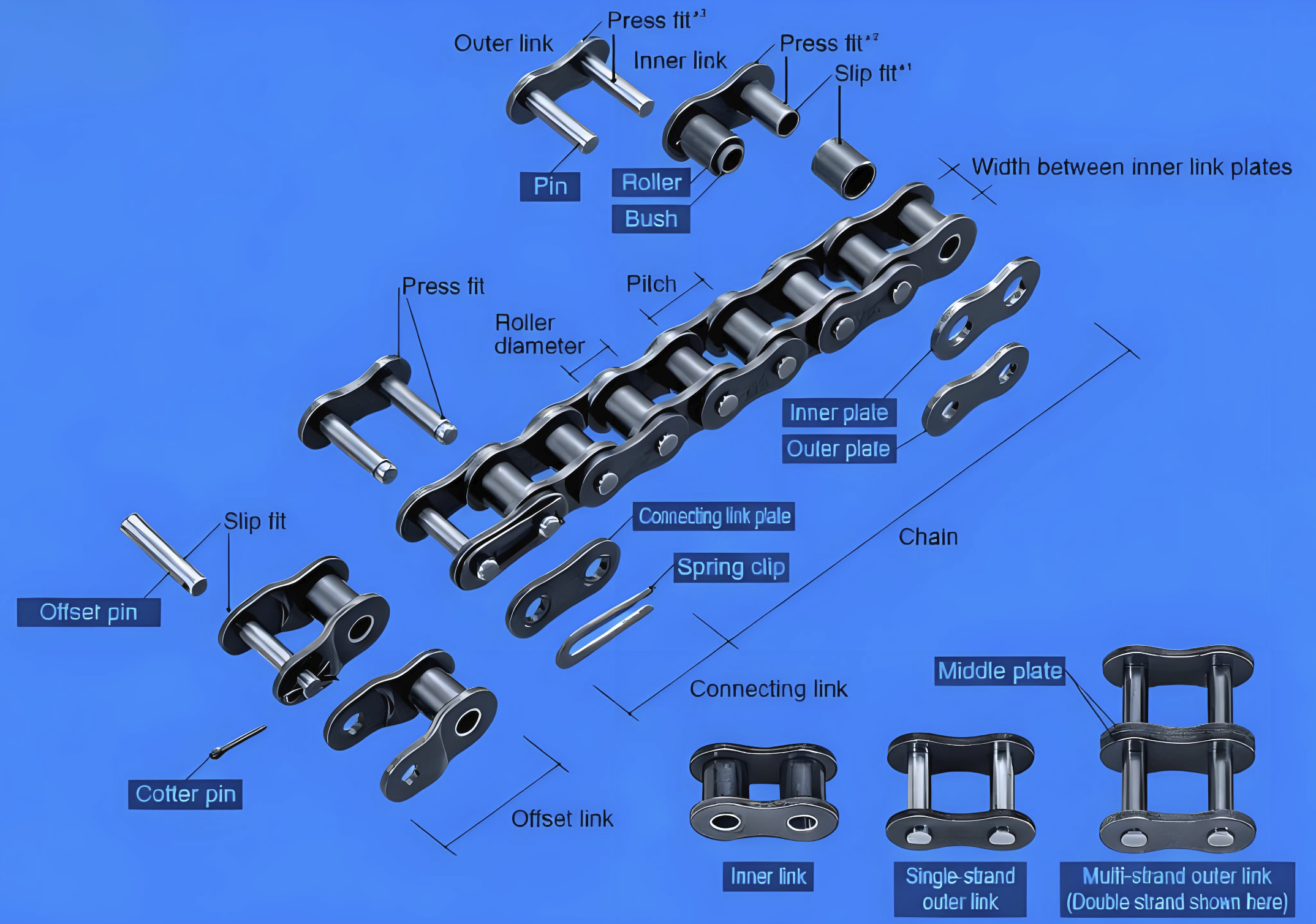
Working Principle:
When the roller chain runs over a sprocket, the rollers engage with the sprocket teeth. As the sprocket turns, the chain transmits mechanical power from one shaft to another. The pins and bushings allow the chain links to flex around the sprocket, while the rollers reduce friction, ensuring smooth and efficient operation. This design allows roller chains to handle high loads, maintain precision, and operate reliably in various industrial applications.
Here’s how roller chains are commonly referred to in various languages:
| Language | Term | Notes |
|---|---|---|
| English | Roller Chain | Standard term in engineering and industrial contexts. |
| Simplified Chinese | 滚子链 | “滚子” = roller, “链” = chain. |
| Traditional Chinese | 滾子鏈 | Traditional script equivalent of simplified Chinese. |
| French | Chaîne à rouleaux | Literally “chain with rollers.” Common in machinery manuals. |
| German | Rollenketten | “Rollen” = rollers, “Ketten” = chains. Widely used in German industrial texts. |
| Spanish | Cadena de rodillos | “Cadena” = chain, “rodillos” = rollers. |
| Portuguese | Corrente de rolos | Standard term in both European and Brazilian Portuguese. |
| Japanese | ローラーチェーン | Katakana transliteration of “roller chain.” Frequently used in technical documents. |
| Korean | 롤러 체인 | Transliteration; also sometimes written as 구동체인 (driving chain). |
| Arabic | سلسلة الأسطوانة | “سلسلة” = chain, “الأسطوانة” = roller/cylinder. Used in technical manuals. |
| Russian | Роликовая цепь | “Роликовая” = roller, “цепь” = chain. Standard in industrial contexts. |
Roller chains are essential in:
Their ability to handle high loads while maintaining precision makes them a reliable solution for many power transmission and material handling systems worldwide.
When sourcing roller chains globally, knowing the correct terminology is crucial. Misunderstandings can result in ordering the wrong specifications, incompatible parts, or delayed shipments. For example:
Understanding roller chains involves more than mechanical knowledge—it also requires awareness of how the concept is communicated across languages. For global engineers, buyers, and manufacturers, mastering these multilingual terms helps streamline international collaboration and ensures that the right products are specified and delivered correctly.
By knowing that a roller chain might be referred to as 滚子链, Rollenketten, or Cadena de rodillos depending on the country, you bridge not only machinery but also communication gaps in the global industrial landscape.